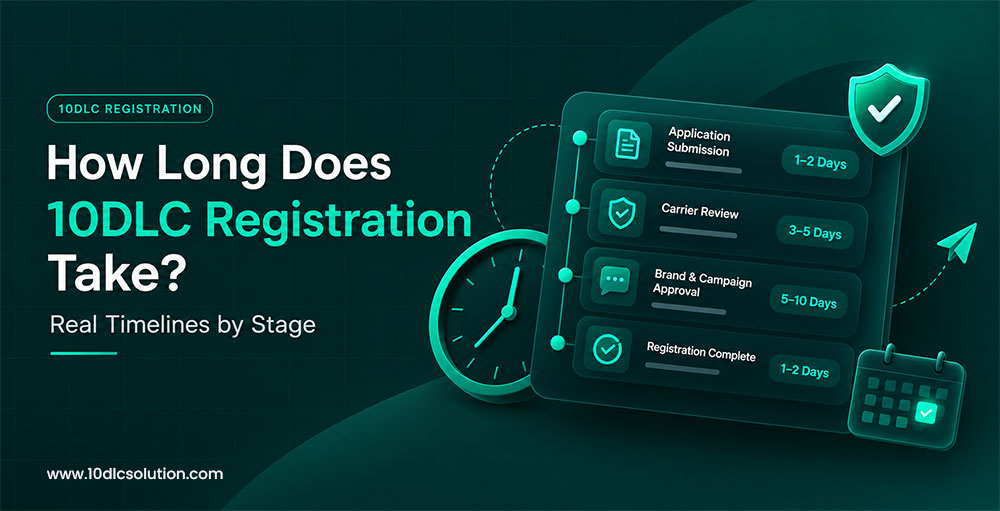
TL;DR
- A well-prepared standard campaign takes 3 to 10 business days end to end.
- 10DLC registration is not one process. It is five independent stages, each with its own queue.
- Brand registration lands in minutes to 3 business days. Campaign review runs 1 day to 4 weeks.
- Optional brand vetting adds 1 to 5 days but raises your trust score and throughput.
- Long timelines are almost always rejection loops, not slow reviewers.
- The registration deadline already passed. Since February 2025, unregistered traffic is blocked outright.
You submitted your registration on Monday. It is now Thursday. Your status still reads "pending," your launch campaign is sitting in a queue, and your provider's support article says approval takes "1 to 5 business days," which tells you almost nothing.
If you have ever asked how long does 10DLC registration take, you have probably noticed that every answer online is a range so wide it is useless for planning. Some sources say a few hours. Others say four weeks. Both are technically correct, because 10DLC registration is not one process. It is a sequence of independent reviews, each with its own queue, its own reviewer, and its own reasons for stalling.
This guide breaks the timeline down stage by stage so you know what is actually happening while you wait, where the delays come from, and what you can control.
The short answer: what a realistic 10DLC timeline looks like
For a well-prepared standard business campaign, expect 3 to 10 business days end to end. That is the honest middle of the distribution.
Here is how the outcomes typically spread out:
- Best case (24 to 72 hours). Established business, clean EIN match, standard use case, compliant website already live, no vetting required.
- Typical case (1 to 2 weeks). Brand approved in 1 to 3 days, campaign approved in 3 to 7 days, possibly one round of revisions.
- Slow case (3 to 6+ weeks). Multiple rejections, missing documentation, restricted or special use case, or a submission stuck behind seasonal review volume.
Industry data from mid-2026 backs this up. Brand approval commonly lands in 1 to 3 business days, while campaign review has been running longer in some queues because of submission volume. Some providers report standard campaigns clearing in roughly 24 to 72 hours with a strong submission, while others quote 10 to 15 days during peak periods.
That gap is not random. It is almost entirely explained by submission quality and use case type.
Stage 1: preparation and documentation (1 to 3 days, fully in your control)
This stage does not appear on any provider's timeline, which is exactly why it surprises people. Before anything gets submitted, you need:
- Your legal business name exactly as it appears on IRS records
- Your EIN, or equivalent tax ID for non-U.S. entities
- Registered business address, business type, and vertical
- A live website with a visible Privacy Policy and Terms of Service
- SMS-specific consent language on whatever form collects phone numbers
- 3 to 5 sample messages that reflect what you will actually send
- Documented proof of opt-in: a screenshot of the form, the keyword flow, or your written consent process
Most teams that report a "two-week registration" actually spent five of those days here, scrambling to update a website that was never built with messaging compliance in mind. Getting your 10DLC registration requirements sorted before you touch the submission form is the cheapest speed you will ever buy.
Stage 2: brand registration (minutes to 3 business days)
Brand registration verifies that your business is real. The Campaign Registry checks your submitted details against public and commercial business records.
When everything matches, this stage can complete in minutes. When it does not, you get a rejection and a resubmission cycle.
What slows brand approval down
- Your legal name is "Northside Dental Group LLC" but you submitted "Northside Dental"
- An EIN typo, or an EIN issued too recently to appear in verification databases
- An address mismatch between your filing and your submission
- Sole proprietors and businesses without an EIN, which face a different and slower path
Azure's messaging documentation notes brand approval commonly takes two to three business days, which is a fair planning assumption even though many approvals are faster.
Stage 3: brand vetting (1 to 5 business days, optional but often worth it)
Vetting is a separate, deeper identity check that produces a trust score. That score directly determines your daily message throughput and how much carrier filtering you face.
You may need vetting if:
- You want higher throughput than your default tier allows
- Your initial trust score came back low
- Your use case or vertical draws extra scrutiny
- You are appealing a score you believe is wrong
Vetting adds days to your timeline, but skipping it when you need volume just moves the problem downstream. A campaign approved at a throttled tier is technically approved and practically useless if you send 50,000 messages a month.
Stage 4: campaign registration and review (1 day to 4 weeks)
This is where the answer to "how long does A2P registration take" gets genuinely unpredictable, because two different reviews happen here.
TCR review
The Campaign Registry validates your use case selection, message samples, opt-in description, and required policy links. Standard use cases generally move fastest.
Carrier and aggregator review
Direct connect aggregators and carriers apply their own rules on top. T-Mobile and AT&T in particular maintain independent review criteria, which is why a campaign can be approved at the registry level and still show as pending downstream.
Realistic campaign timelines by use case
| Use case type | Typical review time |
|---|---|
| Standard: customer care, 2FA, notifications, mixed marketing | 1 to 5 business days |
| Low volume mixed | Same day to 2 days |
| Marketing-heavy or high throughput | 3 to 10 business days |
| Political, charity, emergency, or other special use cases | 2 to 6 weeks |
| Franchise, reseller, or agency-managed campaigns | Add 3 to 7 days |
Special use cases require extra documentation. Agency-managed campaigns add entity verification.
The top reasons campaigns get rejected
Nearly every long timeline traces back to one of these:
- Opt-in language missing or vague. Reviewers want to see exactly how a person consents, where, and what they agreed to receive.
- Website does not support the campaign. No visible Privacy Policy, no SMS disclosure, or a site that does not match the described business.
- Sample messages that do not match the use case. Generic samples like "Your appointment is confirmed" with no brand name, no opt-out instruction, and no context.
- Campaign description under the minimum length or too vague. "Customer notifications" is not a description.
- Content drift between what you registered and what you send. This one gets you audited after approval, not before.
Twilio's own registration best practices guidance stresses the same core point: accuracy and specificity in your submission are what move it through review quickly. Our guide to 10DLC campaign registration covers each of these checks in detail.
Stage 5: number assignment and provisioning (hours to 2 business days)
Once your campaign is approved, your phone numbers still need to be associated with it and propagated across carrier networks. This final step is usually quick, but it is not instant. Plan for up to two business days before throughput is fully live, and send a small test batch before you turn on a real campaign.
Is there still a 10DLC registration deadline?
Not in the way most people mean it. The 10DLC registration deadline has already passed.
Since February 2025, all major U.S. carriers block unregistered A2P traffic from 10-digit numbers outright rather than throttling or filtering it. There is no grace period remaining, and unregistered traffic also carries significantly higher per-message carrier surcharges when it does move at all. If your texts stopped arriving entirely, this is the first thing to check.
The practical takeaway: the only deadline that matters now is your own launch date. Work backward from it by at least two weeks.
How to speed up 10DLC approval
You cannot make reviewers work faster. You can eliminate the rejections that double your timeline.
Match your legal identity exactly
Pull your EIN confirmation letter and copy the name character for character.
Fix the website first
Privacy Policy and Terms live and linked, SMS consent language visible on the opt-in form, and a clear statement that message and data rates may apply and that mobile numbers are not shared with third parties for marketing.
Write specific samples
Include your brand name, a real scenario, and opt-out instructions in at least one sample.
Choose the narrowest accurate use case
Do not register a mixed campaign because it feels flexible. Registered scope should match sent content.
Separate distinct use cases into distinct campaigns
Appointment reminders and promotional blasts on one campaign is a filtering incident waiting to happen.
Submit early in the week
Queues that clear over a weekend cost you two calendar days for free.
Register before you need to send, not after
Registration is not a launch-week task.
For a deeper breakdown of what reviewers look for on each field, our team maintains a full walkthrough of 10DLC registration requirements that covers the submission form line by line.
What to do while you wait
Waiting is not the same as doing nothing. Use the review window to:
- Build and test your opt-out and help keyword handling
- Segment your list by consent source and consent date
- Draft message templates that stay inside your registered use case
- Set up delivery monitoring so you catch filtering the day it starts
- Review your TCPA and state-level consent posture, since carrier approval is not legal compliance
Conclusion
So, how long does 10DLC registration take? For most businesses with a clean submission and a standard use case, three to ten business days. For businesses that submit with a mismatched EIN, a thin website, or vague sample messages, three to six weeks, with most of that time spent in avoidable resubmission loops.
The stages themselves are not slow. Rejections are slow. Every hour you spend tightening your brand details, your consent language, and your sample messages before you submit saves you days on the other side.
If you would rather not learn the rejection reasons the hard way, our team handles brand registration, vetting, campaign submission, and carrier troubleshooting end to end. Start your 10DLC registration with a submission built to pass the first time, or talk to our compliance team if your registration is already stuck in review.
FAQ
Pending usually means your campaign is queued for carrier or aggregator review after registry approval. Mismatched business details, vague opt-in language, or a special use case are the most common causes of extended review.
No. Since February 2025, major U.S. carriers block unregistered A2P traffic from 10-digit numbers entirely. Messages sent before approval will not be delivered, so wait for full campaign provisioning first.
Canada does not use the U.S. 10DLC framework, but Canadian carriers apply their own A2P vetting and consent rules under CASL. If you text U.S. numbers from any location, 10DLC registration is still required.
Expect a small one-time brand registration fee, an optional vetting fee for higher throughput, and a recurring monthly campaign fee that varies by use case. Providers may add their own management charges. The full cost breakdown has the real numbers.
Provider estimates cover registry review only. Carrier and aggregator reviews run separately, and any rejection restarts the queue, so a quoted three-day window can realistically extend to two weeks.